Viking oven bakes cool: sensor, offset, element or door
How to prove a Viking oven is really running cool before you buy a part, what the temperature sensor should read on a meter, why the calibration offset hides real faults, and the point at which the cavity has to come apart.
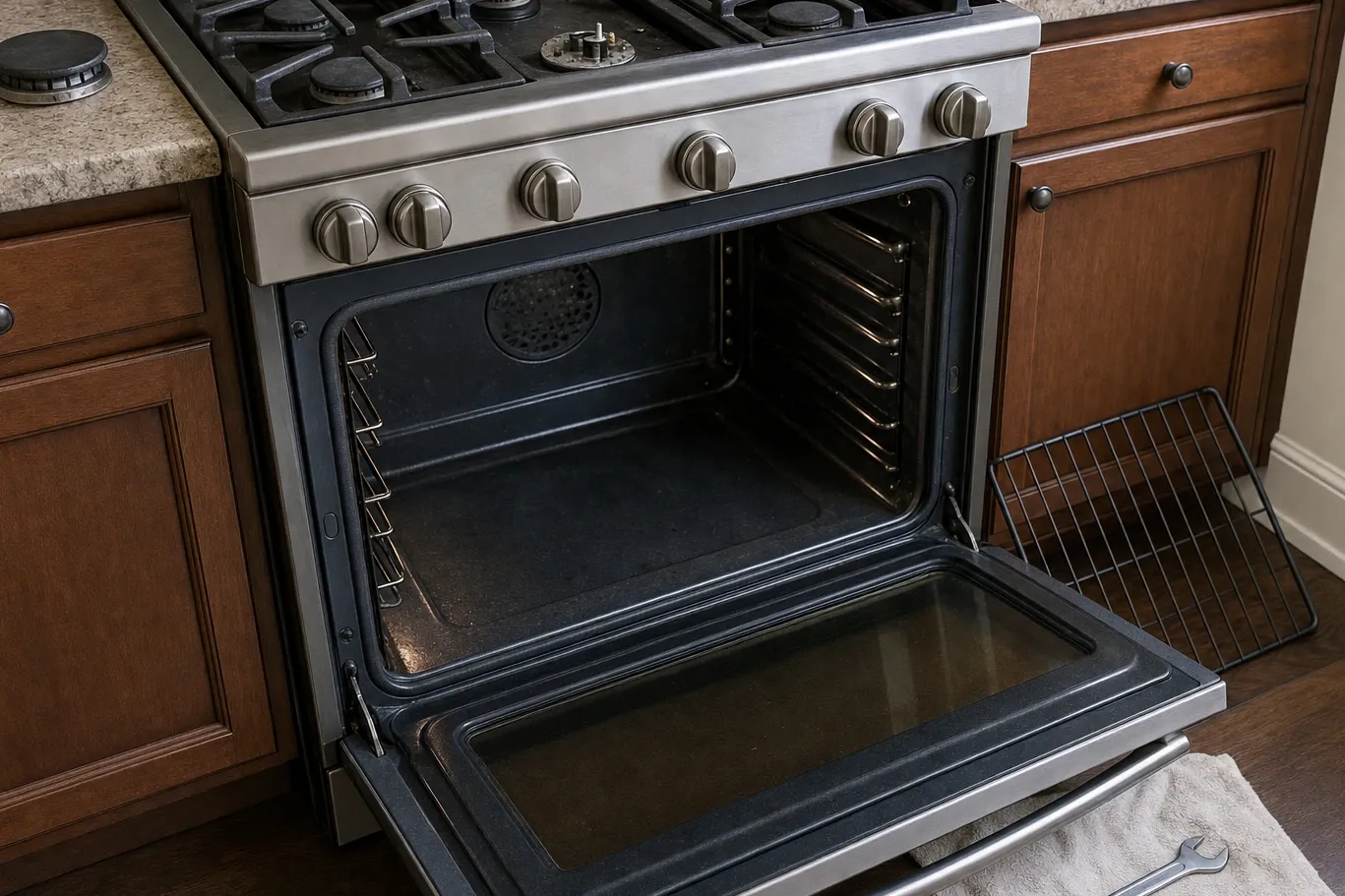
Almost every “my oven is not getting hot enough” call arrives with the same evidence: biscuits that need an extra ten minutes, a roast that finished pale, and a panel insisting it is at 350. Some of those ovens are genuinely running cool. A good number are running fine and being read wrongly, and the difference costs a part and a visit if nobody checks first.
Here is the order the fault is worth working through, from the test that costs nothing to the one that needs the back off the machine.
Cool, or actually cool? Measure it before anything else
The built-in thermometer people trust is the panel display, and the panel display is not a measurement — it is what the control believes. So put something independent in the cavity: an oven thermometer on the centre rack, or better, a probe thermometer with the lead run out through the door seal.
Set the oven to 350, let it preheat, and then leave it alone for a full thirty minutes past the preheat beep. Write down the highest and lowest readings you see. What you are looking for is not a single number but two:
- The average. A cavity averaging within fifteen degrees of the setpoint is behaving.
- The swing. Twenty degrees either side, cycling on a rhythm, is normal. Forty degrees of swing, or a slow climb that never arrives, is not.
Do this before you order anything. An oven that reads 350 on the panel and averages 348 in the cavity has a recipe problem, an altitude problem, or a rack problem — and no part in it will change the outcome.
The temperature sensor and what it should read
Nearly every premium oven built in the last twenty-five years measures cavity temperature with a resistance sensor: a thin metal probe poking through the back wall or the upper left corner. Its resistance climbs in a straight line with temperature, which makes it easy to check and easy to prove.
Cold, at normal room temperature, the sensor should read close to 1,080 ohms across its two terminals. From there it rises roughly two ohms for every degree Fahrenheit — so at 350 it should be somewhere near 1,650. A sensor reading a couple of hundred ohms high is telling the control the cavity is much hotter than it is, and the control obediently shuts the heat off early. That is the classic “bakes cool” fault, and it is one part.
Two things about that measurement matter. Read it at the plug behind the oven rather than at the sensor tip, because you are testing the harness at the same time — a chafed lead against the cavity wall reads the same way as a failed sensor and is a different repair. And read it cold, then again hot, because a sensor that is right cold and wrong hot exists and is otherwise invisible.
Offsets: the setting that hides a real fault
Every oven of this class lets you shift the calibration, usually a range of about thirty-five degrees in either direction through the control panel. It is a legitimate adjustment: cavities do drift with age and a genuine drift is what the offset is for.
It is also the most abused setting on the machine. Somebody finds the oven running cool, adds twenty degrees, and the symptom goes quiet for a season. The following year it needs another twenty. By then nobody knows how much of the reading is real and the actual fault — a tired element, a leaking door, a sensor going off its curve — has had eighteen months to get worse.
So the first thing worth doing on a suspect oven is reading the stored offset and setting it back to zero. Then measure. What the cavity does with no correction applied is the only honest baseline you have, and it is the number a technician wants first.
Elements, igniters and the relay that feeds them
If the sensor is on curve and the offset is zero and the cavity still will not arrive, the heat itself is short.
On an electric cavity that means the bake element or what switches it. An element that has failed open is obvious: no glow, no heat, and it usually reads open on a meter. Far more common is an element that still works and a relay on the control board that has stopped pulling in reliably — the tell is a bake side that behaves for twenty minutes and then quits, or one that works from cold and never after a self-clean. Both need current measured under load, with the machine hot, which is why this is where the DIY route usually ends.
On a gas cavity the equivalent is the igniter. A hot-surface igniter weakens with age and draws less current as it goes; below the threshold the safety valve will not open, so the igniter glows away and the gas never comes. It looks perfectly healthy. It is the single most common reason a gas oven takes an hour to reach a temperature it used to reach in fifteen minutes, and it is measured with a clamp meter rather than judged by eye.
The door, the hinge and the heat you are throwing away
The last suspect is the cheapest to prove and the easiest to overlook. Heat that leaves the cavity has to be replaced, and a door that is not sealing means an oven that runs constantly and still bakes cool.
Look at the top corners with the door shut. A gap you can see is a gap that matters. Check whether the door needs a push to latch, and whether it drops the last inch by itself — both are hinge springs that have lost tension. Run a hand around the gasket for hard, glazed sections, which is where a kitchen that lives at ninety degrees for four months a year does its damage.
A door repair is a hinge, a spring or a gasket. It is unglamorous, it is the kind of thing an owner can often see for themselves, and it fixes ovens that have already had an element thrown at them for no reason.
Where it is worth a technician
The line is roughly this. Independent measurement, resetting the offset, a resistance check on the sensor and a look at the door are all reasonable to do yourself, and they resolve a fair share of these calls without anybody visiting.
Current under load, relay behaviour on a live board, igniter draw and anything that means removing the back panel are not. Those are mains-voltage or gas-side measurements taken on a hot machine, and the cost of getting them wrong is not the price of the part.
What is worth having ready if you do ring: the model and serial number off the plate inside the door frame, the average temperature you measured and the setpoint you measured it at, whether the offset was reset, and whether the fault is from cold or only after the oven has been running a while. That is a diagnosis half done before anyone arrives.
Follow-up questions
- How far out does an oven have to be before it counts as a fault?
- A cavity that swings twenty degrees either side of the setpoint while cycling is normal on a gas oven and unremarkable on an electric one. What is not normal is an average that sits low across a whole hour — if the mean is twenty-five degrees or more under the setpoint, or the cavity never gets there at all, something is wrong beyond the character of the machine.
- Can I just set the calibration offset and forget about it?
- You can, and for a genuinely drifted oven that is the correct repair. But an offset only shifts what the control aims for; it cannot make a weak element hotter or stop a door leaking heat. If you find yourself adding more offset every few months, the offset is not the fix — it is hiding the fault that is getting worse.
- Everything comes out pale on the bottom and burnt on top. Same fault?
- Different one. Uneven browning with a correct average temperature is airflow and placement: a convection fan that has slowed, a blocked vent, or a rack in the wrong position with a heavy tray under it. Measure the average first — if the average is right, stop looking at the element and start looking at the air.
- Does the desert heat affect a built-in oven the way it does refrigeration?
- Not in the same direct way, but it shows up twice. A kitchen sitting at ninety-plus degrees for months bakes the door gasket hard and the seal is then the first thing to go, and summer power events take control boards and relays with them. Both arrive as an oven that has quietly stopped reaching temperature.
Written by
Jonas Eriksson
Service technician — doors, hinges and alignment · 20 years in the trade
Checks how a door sits before checking what it is wired to. Hinges that have lost tension explain more running-time complaints than any control board ever has.